
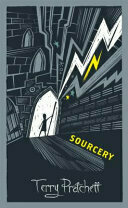
Finished reading: Sourcery by Terry Pratchett 📚. Not strictly spoiler-free, if that concerns you.
I’ve been reading the Discworld books very out-of-order, in terms of the wider chronology, except never to skip a book within a subseries. This has meant getting lost a few times, in terms of some of the secondary characters and where their arc is at, at any given time.
So far, the first two books (The Colour of Magic and The Light Fantastic) were my least-favourite. Sir Terry was still finding his voice in terms of the macro stuff (storytelling structure, themes and where the secondary characters fit the themes, pacing). Characters who are much better-developed in later books have entirely different personalities in the first few (Death in particular). The reason this is relevant to Sourcery is that Sourcery comes many books later, but is the next in the Unseen University series.
Sourcery finally starts giving Rincewind and his strange, unique position in the Discworld a sense of depth and complexity, tacitly asking the questions “why does Rincewind want to be a wizard” and “what the heck does that even mean” over and over. (His previous entries didn’t have that opportunity for plot and worldbuilding reasons.) The antagonist and problem of the story are the perfect mirrors for that question — set up in the prologue, someone who is so thoroughly born to their talents and so intrinsically forced into their role that the question isn’t merely not asked, but impossible. The result is a bookful of fun, on-theme character work, on a level that (so far) is only bested by the Night’s Watch series.
The secondary characters let Sourcery down. I feel bad saying that, because the words “excuse me” had me laughing out loud for several minutes; some of the funniest moments I’ve ever read in a book come from the secondary characters in this book, and the way they hold up a mirror to Rincewind’s journey is inextricable from the journey itself. But story-wise, the secondary characters quietly get dropped and neglected as of partway through the main plot, which feels deflating after all the time spent building up their involvement and importance. I’d have liked to see them get to complete their own little story arcs.
On to the next book!